
(On Making Me Look Good)
My high school dramatics-coach career lasted an incredible quarter of a century+. I’ve counted and before it was over, I’d directed/co-directed fifty-two high school plays and/or musicals. But believe me, had some crystal-ball fortune teller ever prophesied such a terrifying future to me, I would have run away and joined the circus. Nobody knew more than I just how unqualified I was to fulfill such a prediction.
So what happened? A rocky start. That’s what happened. So many things would go wrong. No big surprise considering I was the guy who’d virtually wilt at the prospect of being commissioned to pilot such an above-his-pay-grade helm.
Take for instance the ordeal of my first time being tasked with three one-act plays to produce and direct on my own at Foxcroft Academy. I say on my own because it wasn’t like it had been eleven years ago at Belfast when I’d inherited an army (The Footlights Club) who could’ve/would’ve managed just fine with or without me. No, there was no army to carry me through and make me look good this time.
So what went wrong? Well, right off the bat, two of my best and brightest plays fizzled right out from under me due to critical absenteeism at scheduled practices. That was crushing. The professional embarrassment over such a failure! I couldn’t figure out how other directors somehow managed to strong-arm their players into seeing that showing-up-at-rehearsals is a very big priority. Me? No General Patton. All I was is just some passive little ‘know-little’ who happened to have accidentally parachuted into the “director’s” chair, and was just going through the motions because, honestly…? I’m ashamed to say I simply didn’t know how to do it.

So there I was, Nervous Norvous me, left only with my B-side play, the least important of the three; a silly, childish piece of fluff titled “Once Upon A Playground,” the one I’d basically inserted into the program only as a filler. Talk about feeling naked.
So despite the fact that I wanted to gather up my family and run away to Canada, we were required to do the play in front of the Academy’s student body first, once that evening, and then once more for the kids in the lower grades the next day. I was going to die!
I remember the feeling of abject shame right down to the pit of my stomach while hearing the sound of the audience, quieting right down to watch as the curtains finally swept apart for our first performance of my fiasco. It was Zero hour. D-Day. And oh how I pitied my kids for having had the bad luck to end up with… me. And now everybody would know, would see with their own eyes, just what an incompetent loser I was as the so-called “director.”
Backstage, and following along with my script, I listened to my kids out there begin delivering their memorized lines. What an empty little play, the voice in my head harangued. What was I ever THINKING?
About three minutes into the play, I was startled practically out of my shoes by a thunderous, raffish noise that sounded something like a crash! Two seconds later in, I’d identified the ‘concussion’ as… laughter. Audience laughter!
Ohmigod! Was that a contemptuous laugh???
Utterly confused I looked down upon the last delivered line. Huh! OK. Yeah, it was… kind of a funny line… but that funny? And by then of course the show was moving on at its inevitable clip, totally out of my control. But before long…
It happened again! Another volley of belly laughs. And not sounding one bit mean-spirited either! And then another one. What the heck was going on?!
What was going on was that the play was working! Somehow succeeding way beyond my mousy, second-guessing expectations. It had never occurred to me that, duh (a) the playwright knew what he was doing when he wrote the thing, that he was good at what he did for his living, and that (b) the kids I’d cast could be trusted to do their part at making the thing work. What a surprise.
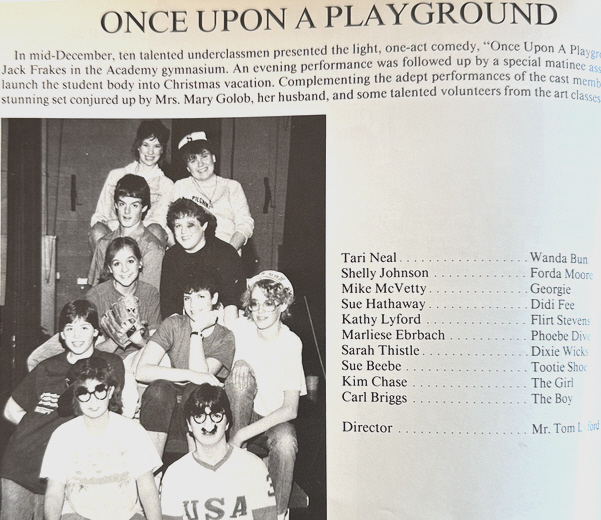
But here’s the real reason this dinky little offering somehow finally got off the ground? It turned out that I had two little freshman firecrackers in that cast, two young women who had SO much Pollyanna-esque-optimism and drive to, first and foremost, just be in plays and secondly, once cast, to do everything in their power to make those plays succeed.
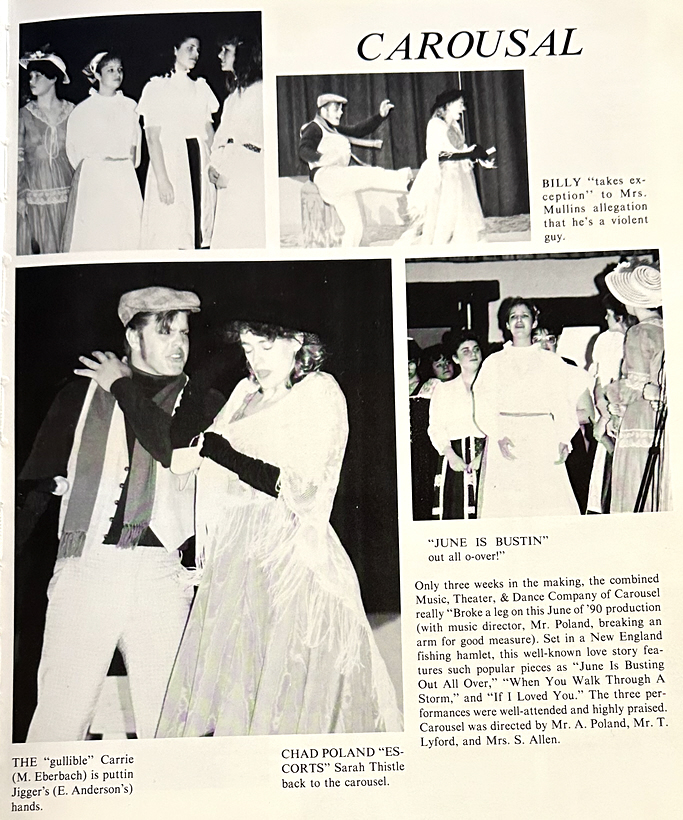
That’s the truth. And my God, I had no way of imagining the walloping impact this duo was destined to have on not only me over the next four years but also on Foxcroft Academy’s dramatics program overall. God bless the freshmen, Sarah Thistle and Marliese Eberbach!
So know this: the overall, underlying purpose of me writing this post is… all about me setting the record straight. Because of them, I ended up getting one hell of a great reputation over a number of years as an award-winning drama coach. But that’s not where the bulk of the credit should have gone.
So here it is: this is all about me giving credit where the credit’s due.
~ ~ ~ ~ ~ ~ ~ ~ ~ ~ ~ ~
OK. Let me back up a little first.
The first time I held auditions as the new director, something quickly became clear to me: on the one hand, I had a handful of underclassmen who’d come in with the greatest of hopes to be chosen. It was obvious that The Try-Out was something of great importance to them. And… not only had they come to me so admirably prepared, but also with an unbelievable ethic of teamwork and support for one another. Like, I mean they were altruistically helping each other get prepared for their readings, giving each other selfless encouragement to others in the hopes that they too might succeed, rather than approaching the whole ordeal with the hostile intent of a dog-eat-dog competition.
On the other hand was the gang of upperclassmen boys and girls who arrived all cocky, smirking, and openly sneering at their inexperienced, younger counterparts… and right in front of me. Oh yes, they knew this was an open “audition” alright, and yet their vibe was, We don’ neeed no steenkin’ try-outs. Us getting all the juiciest parts? That’s a foregone conclusion, it’s in the bag. Because we’re the varsity and that’s just the way it goes, you losers.
And although I had serious qualms about doing it (and as a result had to endure a long period of guiltily second-guessing myself thereafter)… I assigned roles not to those who seemed to have the most credentials necessarily, but to those who actually demonstrated the most skill, energy, and desire during the audition. Meaning that a lot of those juniors and seniors got dumped in favor of underclassmen who had just honestly earned their places with hard work and talent, damnit!
And oh, what a high school, drama-queen scandal that turned out to be! Upperclassmen’s parents were not happy campers. And the dumpees? Dumbfounded, yet mad as wet hens. But... in the long run, it turned out the best thing I ever could have done. For the kids, for me, and especially for the Academy’s drama program.
And so yes, my directorial career had to get shakily jump-started with the frivolous “Once Upon the Playground.” And I couldn’t believe it got such an enthusiastic reception. Because I guess me, being the dyed-in-the-wool college English major, I was feeling my job required more literarily-meaty offerings with dark and complex themes, overtones, symbolism, double-entendres, and elements of existentialism… which is pretty much why shortly after “Playground,” I opted to put on Albee’s “The Zoo Story,” the one-act featured in my last post.
How pretentious of me. I had so much to learn.
So my tenure got off to an embarrassing, molasses crawl over the first couple of seasons. Reason being, (besides not having a hint of a clue as to how to proceed) I was choosing my plays from among the same musty, curmudgeonly classic titles that F.A. had been putting on since back when I was a student. And my God, weren’t they ever talky and boring!
So one day, I pushed myself to begin to look for something new. Something unique. And I started sending away for play catalogues from all over the country. And as summer vacation loomed, I was deep into poring over the descriptions of many much-more-interesting-sounding, just-published scripts.
Script-reading turned out to be fun. To me, the script catalogs were like the old Sears and Roebuck Christmas Toy Catalogs, each play description sending visions of sugar plums of all the props and costumes we would need to get dancing in my imagination.
So I started ordering. Like a madman! Perusing scripts became my newest hobby, and I found myself rabidly getting into it. For a ‘know-little director,’ at least this was something I could do. And my burgeoning script-library began filling up mostly with some very odd titles such as “Postponing the Heat Death of the Universe,” SECOND Prize: TWO Months in Leningrad,” and “Nice People Dancing to Good Country Music.” As time went on it got so that before I felt confident about a purchasing a title for my program, I’d honestly ended up reading close to a hundred scripts. And I’m talking each year! (Did I mention that I’m a little obsessive-compulsive?)
Picking the Perfect Play developed into one of my unique Super Powers (OK, let’s just call them my stronger suits, my forte if you will). Say anything you want about me but, damn, I could pick a great play. The other super power being that I was actually very good at coaxing kids out of their little shells, and really releasing and expressing their emotions effectively. But that’s it. That’s all I had. Other than that… I was just some friggin’ moron in the field. But anyway, one day…
Ding! I’d found it! The best play out there! Something brand new and odd and unique in the catalogs, something just published too, something that no one in the entire state had probably heard of yet, let alone had seen performed. Something deliciously unusual.
(from the catalog…)
INCIDENT AT SAN BAJO by Brad Korbesmeyer Short Play, Drama / 4w, 3m
The residents of a trailer camp have quite a story to tell. A stranger tried to sell each of them a mysterious elixir which he claimed would make them live longer. Most, of course, did not buy the elixir –and they are now dead, the water supply having been poisoned by the stranger. Only seven are left to tell the tale– the seven who drank the elixir which, it turned out, was an antidote! Each of their stories is told in a series of interlocking monologues directed at an unseen interviewer. The effect is somewhat like a “60 Minutes” segment.
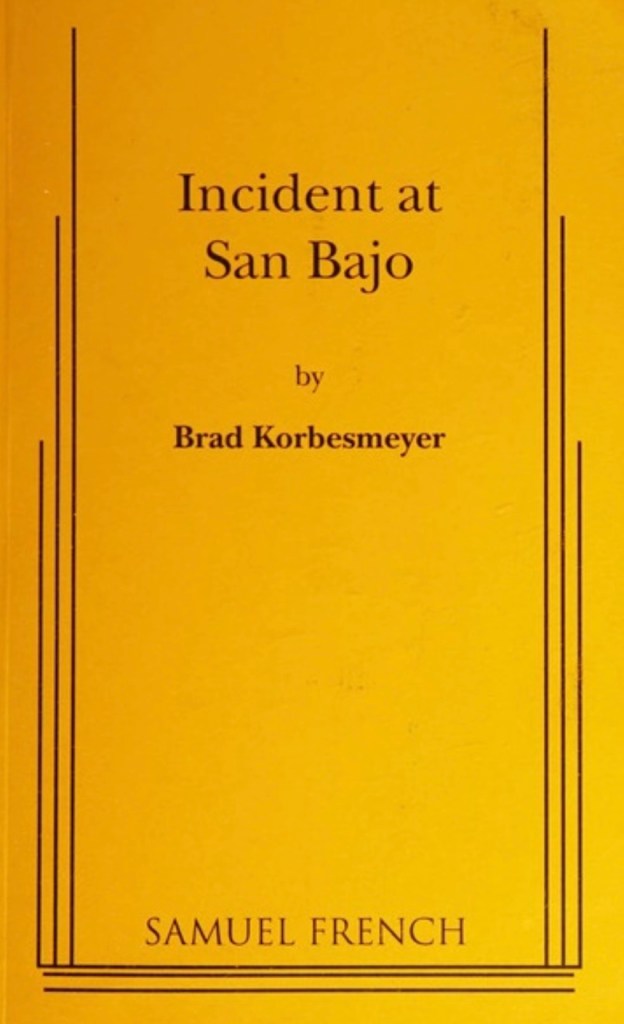
Yes! This was the one! And when I ordered my dozen copies of the “San Bajo” script, I actually felt excited to be committing us to a different sort of play at least. And when I began our first meeting with my, “OK kids, here’re your copies. This is the play we’re doing. First read-through is right now… I felt a curious little spike in my heart-rate, a little blip of passion that was beginning to go right to work at countering the usual dread that normally handicapped my heart in these endeavors. Because this one was unlike any play I had read before.
What I had no idea of was that this was the play that was going to change everything.
~ ~ ~ ~ ~ ~ ~ ~ ~ ~ ~ ~
Early on, I’d decided (in order to set the dark and mysterious tone of the piece) that the first thing I wanted the audience to hear while waiting for the curtains to open would be Bob Dylan’s “The Man in the Long Black Coat.” That song is captivating, lurking, spooky, and evocative of some mysterious event so very like “The Incident at San Bajo” it was uncanny.
You don’t have to listen to the whole thing, as we were only going to use the first minute and a half. But here, take a quick listen if you will and try to imagine you’re seated in a packed auditorium waiting on the curtains to swish open, and then this mood-setter starts up. Close your eyes and see where the music takes you. Listen to the tone. Listen to… the crickets:
Most often I’d have that piece playing while the kids came in and took to setting up the rehearsal stage. And right away a positive sea-change overtook the spirit of our rehearsals, which were becoming a labor of love.
Because this little newcomer in the catalogs was a unique ensemble piece wherein each actor is given a coequal starring role, it is an actor’s dream. Each of the seven individual players is intermittently a star in his/her own right, simultaneously occupying one of the six “stations” spread left-to-right across the stage (one station being occupied by a “married couple” together). When the single spotlight is highlighting one of the stations, the other five are left frozen, out of sight in silent darkness. Each “station” is an off-and-on little “micro-world” of its own.
Sure, the entire play is set in the one-and-the-same trailer park— each character being one of the trailer park’s trailer-trash losers. But each is being interviewed in his/her own “mobile home” individually— one, a guy a who’s a conspiracy-theory-ranting gas station attendant; an octogenarian spinster; a wannabe-suave ladies’ man in a smoking jacket, sipping bourbon; a middle-aged, new-age, lady-psychic scammer; and a shallow yuppie couple hell-bent on keeping up with all the latest trends. Point being: the physical space each character occupies on stage is a disparate little time-space microcosm, replete with that character’s emotional, educational, psychological, and spiritual plane. An actor’s dream.
The audience never hears the interviewer’s voiced questions, but of course the characters’ responses make the prompts obvious.
~ ~ ~ ~ ~ ~ ~ ~ ~ ~ ~ ~
So along with the two other one-acts, we put “The Incident at San Bajo” on in front of the school and then the community. We were a big hit. Then it was time to board the bus and head out to the Maine State Principals’ Association Regional One-Act Play Competitions.
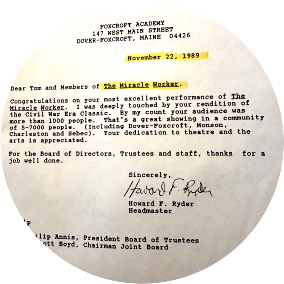
The Regionals never know what hit’em. We took them completely by surprise and by storm. “San Bajo” steamrolled right over the other schools. Not only did we take first place, but each and every individual of the seven took home his/her own much coveted All-Cast Festival Award, a rare accomplishment. And when it was all over, everybody was talking about the play itself, and about us.

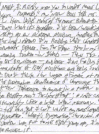
(below, an encouraging note from our supportive headmaster)

So two weeks later, we hit the States on a roll… but immediately found ourselves humbled. We were up against the much bigger schools, a lot of them, and it showed— bigger schools with fatter wallets, humongous programs, and decades of greater experience, schools who were used to winning.
We were the small school underdogs, ripe for failure…
Such an interesting thing though, these competitions. Your big yellow school bus stops at a local motel for you all to drop the bags and suitcases into your assigned rooms, and then you rush to get right back on the bus. Next, over at the host school, you unload all the props, register yourselves at the welcoming table in the school lobby, get your festival badges, get escorted to your assigned to a classroom (which will be your home base over the next two days), get handed your programs, discover what time of day (Saturday or Sunday) your play is scheduled to hit the stage, and then you just sort of dissolve into the chattering crowds for a bit.
It’s a time for all the kids to meet and befriend their competitors, while the directors do likewise. There are three sessions each day: morning, afternoon, and evening— each one followed by The Unnerving Critique where your cast and crew (with their little tails between their legs, most likely) get herded into the designated ‘Judges’ Classroom’ and face the music.
It’s kind of like a rodeo.
Over the entire weekend you’re seated with your crew in the auditorium (watching all the other schools perform their little hearts out), seated in the cafeteria for the lunches, or seated in your assigned classroom going over and over your lines.
But you know, it’s a wonderful thing, getting to watch the spunk and the amazing creativity of all those various high school students on parade. Often daunting too, because you do find yourself struggling with imagining just how well your play might get measured up against the ones you’re watching.
But somewhere during those seemingly endless two days comes That Heart Attack Moment! It’s… your turn!
~ ~ ~ ~ ~ ~ ~ ~ ~ ~ ~ ~
Thank goodness I’d chosen the first two-minutes of Bob Dylan’s “The Man in the Long Black Coat” as our intro for “San Bajo.” Because while we were toiling at the last-minute tweaks of our props set-up back-stage, in the semi-darkness back there behind those closed curtains, the lethargic tempo of that music (which was soft and slow, and contained the sound of the night-time chirping of crickets) felt familiar and comfortable, and seemed to calm us all right down. Seemed to make the whole thing feel that this was nothing more than just another dress rehearsal back home.
My visual memory of those last moments have the actors, like busy, little, methodical shadows, silently tip-toeing about the stage, and moving things around in slow motion.
And then OMG! The curtains swept open. And there we were.

~ ~ ~ ~ ~ ~ ~ ~ ~ ~ ~ ~
OK, so no, we didn’t win. The competition was really stiff. Still, what we did do is knock the socks off everyone! So it was a moral victory. There is no third place trophy, at least there wasn’t at the time (1990), but according to the judges’ notes, that’s where we placed. Sure, we’d have liked to have won, but the enthusiasm that was showered upon us from all the other directors and cast members throughout the rest of the festival left us all very proud.
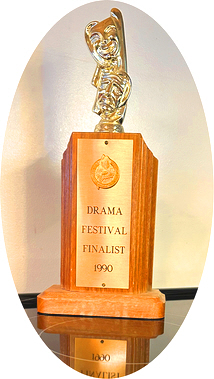
But… look at us: WE’D MADE IT TO STATES!! And so yes, this was the play, and the cast, that began making all the difference in the Academy’s dramatics program over the next ten years back then.
So with FA’s student body back home already awed by our stellar performance on the hometown stage, some changes were in store. For one, it immediately became a lot easier for me to get boys to try out for the plays. When I’d begun, 98% of those trying out were females, while 98% of the scripts I could get my hands on called for mostly guys. Secondly, over time our productions began drawing larger and larger audiences, not just the parents and families of our cast members anymore, but seriously interested theater-goers from the neighboring towns and general area were showing up. So we were steadily building a reputation, which meant our program was beginning to haul in more money on ticket sales for a change.
So, “Incident at San Bajo” really had put us on the map. But does that mean I finally got over my Nervous Norvousness as a director? Hah! Nope. Not at all. It just meant more ulcers for me. Don’t get me wrong. I loved seeing the plays I’d selected do so well. But there were always, every single time, those lingering terrors threatening to, you know, unexpectedly collapse everything… all those what-IFS that could end a play in disaster in the wink of a poked eye.
I just wasn’t cut out for a tension-filled career.
But my actors were. They thrived on it. Things did go wrong, of course. But my kids always took care of those things. They were amazing. So it’s embarrassing for me to have gotten the credit for the way our dramatics program took off over the next decade. Yes, I picked great plays. I can take credit for that. And yes, I was pretty good at getting kids to let their emotions loose, and to project their voices. But that was it. The only other thing that I was good at was… well, letting go of things, letting my amazing crackerjack kids loose on each play. They were wonderful.


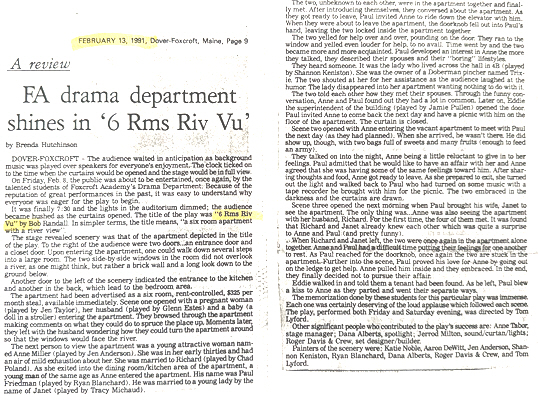
So here I am, setting the record straight: The lion’s share of the credit for making Foxcroft Academy shine in dramatics and helping the drama program grow and improve during my tenure goes to the kids, the little actors I was so blessed to get the chance to be associated with. And this is especially true for the three above, my drama wunderkinder: the amazing Sarah Thistle, Marliese Eberbach, and Pat Myers, all members of the class of 1994. They put their magic into those “great plays” I selected. They made each one simply fly. They made me practically famous as a director.
Only it wasn’t me. It was them.
I was only picking the plays and sort of going along for the ride…
And look at what a ride it was…


Et Cetera…
Ah, those halcyon days (with ulcer)…
Feel free to leave a comment if you wish in the field below, and then simply click on “POST COMMENT.” I will respond…
Consider subscribing. Just type your email into the field below and click on “SUBSCRIBE.” Subscribing only means that whenever I post a new episode, you’ll receive an email link to that new post, nothing more. And you can always unsubscribe at any time…
Thanks for reading. To return to the Main Menu (a listing of all my earlier blog post choices) simply click on “CLICK HERE TO ACCESS THE MENU…” below…


























































 NEARING THE END OF THE LINE
Leave a comment